


Suppose that a client sees the dusty tables and runs to your rival. In Los Angeles, cutthroat markets, where hygiene is judged first by 70% of the markets, that is, revenue is gone. What is commercial cleaning? Searching: commercial cleaning. It has impeccable services of immaculate offices, shopping areas, and clinics that enhance impressions. Unclean areas breed germs, reduce productivity by 15% drop, and expose the organization to fines. Don’t let it happen.
This guide unpacks definitions, services, types, and hiring hacks in order to make your business shine. Dive in and dominate!
What Is Commercial Cleaning?
Commercial cleaning refers to professional cleaning services designed for non-residential spaces like offices, retail stores, schools, and medical facilities. Unlike everyday tidying, it involves specialized techniques, equipment, and eco-friendly products to handle high-traffic areas efficiently and safely.
The major distinction between domestic and commercial cleaning is the volume and difficulty. Home cleaning works on a house-by-house basis with more personalized services, such as dusting family photos, whereas commercial cleaning addresses more massive quantities. An example is stripping out industrial floors or cleaning high-contact surfaces in a crowded lobby to comply with health requirements.
Commercial Cleaning Meaning Explained
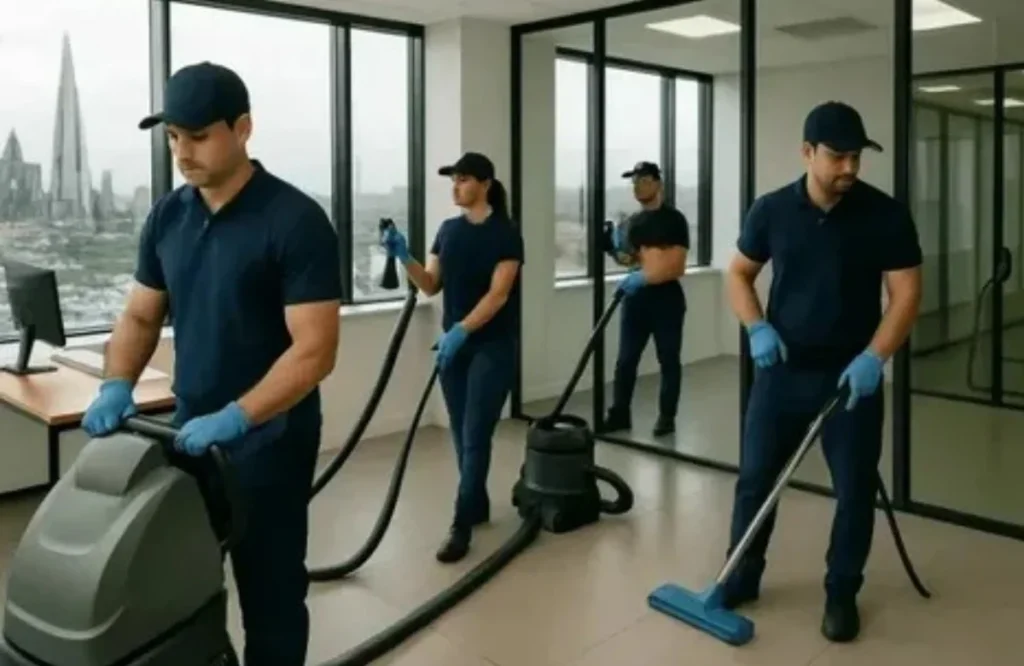
In essence, commercial cleaning simply reduces to ensuring that the business areas are kept hygienically and functionally fit. It is more than surface-level wipes to eliminate germs and bacteria, meet the regulations, and boost the morale of employees. An example could be a typical office that requires vacuums each day of 10,000 + square feet, which does not compare with home cleaning.
What Is Considered Commercial Cleaning?
What does one mean by commercial cleaning? It deals with any professional service to business premises, big boutiques or huge warehouses. Such services are what make spaces safe, welcoming, and running as they are in continuous use.
Examples of Commercial Cleaning Environments
Common spots include:
- Co-working and corporate offices.
- Shopfronts and shopping malls.
- Clinics, dental clinics, and hospitals.
- Schools, universities, and daycare centers.
- Distribution centers, warehouses, and factories.
- Restaurants, gyms, and hotels.
Every setting requires specific solutions, such as HEPA-filter vacuums in the allergy-sensitive schools or antimicrobial use in the hospital.
What Is Commercial Housekeeping?
Commercial housekeeping places a focus on continuity as well as organization in the business and often coincides with cleaning, but is concerned with preventive services like trash disposal and replenishment of stock.
It is not similar to normal cleaning, where prevention is done through the normal garbage collection and surface cleaning to prevent the clutters to accumulate, but normal cleaning may be of a reactive type, such as the deep cleaning after an event has taken place.
Commercial Housekeeping vs Janitorial Services
| Aspect | Commercial Housekeeping | Janitorial Services |
| Focus | Daily upkeep, organization, light cleaning | Thorough cleaning, floor care, disinfection |
| Frequency | Ongoing (hourly/daily) | Scheduled (daily/weekly) |
| Typical Tasks | Dusting, trash removal, restocking | Mopping, window washing, carpet shampooing |
| Best For | Hotels, offices for seamless operations | Retail, schools for deep hygiene |
Housekeeping keeps things running smoothly; janitorial dives deeper into sanitation.
What Does Commercial Cleaning Include?
Commercial cleaning consists of what? It is much more than a mere wipe-down plan since it incorporates a complete range of routine and specialized work that fits high-traffic businesses. Daily vacuuming the floor, sanitization of high-contact surfaces, and even more thorough cleans, such as carpet extraction and HVAC sanitization, are the services performed with tools of the commercial grade and environmentally-friendly products. The goal? Sanitized rooms that have no downtime, personalized to your business, be it an overcrowded office in Los Angeles or a clean clinic.
The professionals will adjust the schedules to low-traffic periods so that your operations can run smoothly. With this all-round solution, not only is raised but also the life of your assets, such as the floors and furniture, prolonged, which saves thousands of replacements.
Daily Commercial Cleaning Tasks
These elementary obligations are performed either in the morning or evening, or before or after the shifts, every single night, to receive a clean slate:
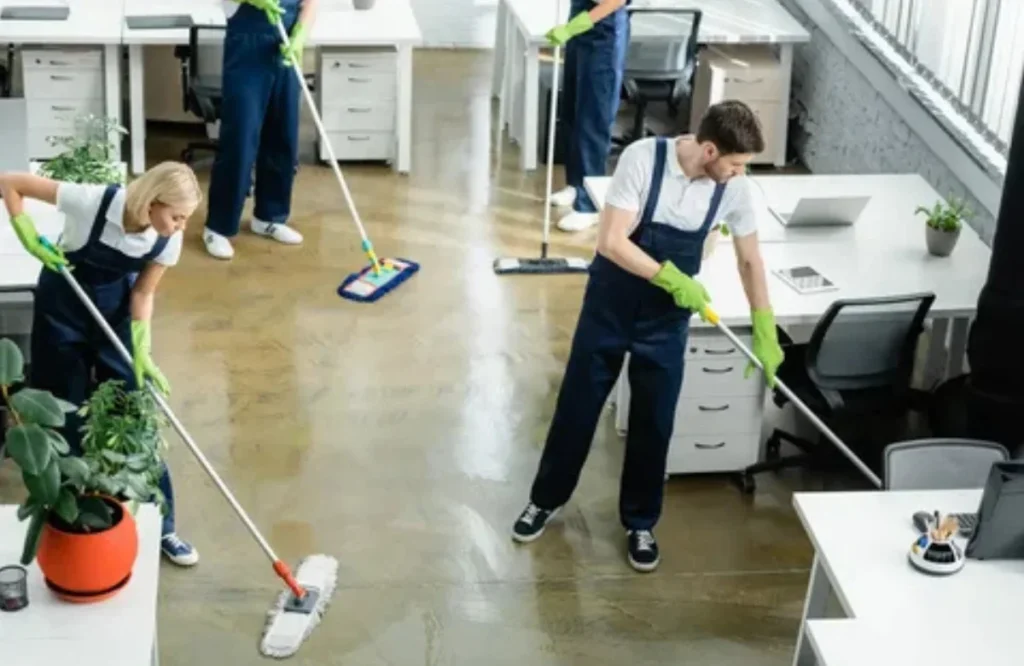
- Cleaning of the high-traffic floors by mopping and vacuuming using HEPA filters to collect allergens.
- Cleaning garbage cans, sorting, and disinfecting cans.
- Washing the doorknobs, lifts, keyboards and toilets with hospital-grade disinfectants.
- Desk wiping, shelf wiping, overhead wiping, and blinds wiping to remove dust.
- Washing the doorknobs, lifts, keyboards and toilets with hospital-grade disinfectants.
- Mirrors, partitions, glass doors, clean to crystal-clear.
The routine will help in saving sick days at a 50-employee office since the spread of germs will be prevented.
Periodic & Deep Cleaning Services
Arranged after a week, every two weeks, or one month in deep rest:
- Steaming of the carpets to remove stains and to remove odor to rejuvenate the fibers.
- High-shine slip-resistant polishing, floor waxing or buffing.
- Cleaning of exterior/interior windows and dusting hard-to-reach areas (i.e., ceilings, vents, etc.)
- Washing the exterior of buildings, sidewalks and loading docks.
- Sanitization of air ducts and coils cleaning to enhance air quality and HVAC performance.
These services are in accordance with the health requirements of the USA. Companies boast 20-30% higher levels of satisfaction with employees after a deep clean.
What Is a Commercial Cleaner?
A business cleaner is a specialist who cleans business premises, is trained, and uses high-grade cleaning equipment to keep the standards of hygiene.
Commercial cleaner definition: Specialists who are prepared to work on scale, safety, and efficiency in non-residential areas.
What Does a Commercial Cleaner Do?
What is the work of a commercial cleaner? OSHA guidelines, floor buffer work, and utilization of environmentally friendly disinfectants make up the daily activities. One day, they can power-wash loading docks and the next day, they can finish detailing medical exam rooms, but always with the least amount of downtime.
Types of Commercial Cleaning Services
A discussion on the types of commercial cleaning services aids in aligning services with the space. Here’s a breakdown:
Office Cleaning Services
Cubicle and conference room-specific: Desk cleaning, kitchenette wiping, and ergonomics to increase productivity.
Retail & Storefront Cleaning
Daily polishing of floors, display of windows, and dusting of fixtures to welcome shoppers and always keep the brand image fresh.
Cleaning of Medical and Healthcare facilities
Patient safety, sterile procedures using hospital-grade disinfectants, biohazard disposal, and a high-efficiency particulate air filter (HEPA).
Industrial & Warehouse Cleaning
Hard labor such as de-greasing of equipment, cleaning of concrete floors, and handling of hazardous wastes.
School & Educational Facility Cleaning
Kid-friendly, allergen-reducing services: playground sanitizing, cafeteria deep cleans, and classroom blackboard wiping.
Commercial Cleaning and Janitorial Services: What’s the Difference?
Commercial cleaning and janitorial services often overlap and are required by various individuals. Cleaning is a broad and task-oriented field; janitorial services introduce activities such as checking restrooms during working hours.
When to Choose Commercial Cleaning vs Janitorial Services
And use commercial cleaning, either one-off deep cleaning or regular maintenance. Select janitorial to be present on-site and daily in high-traffic areas, such as malls.
Why Businesses Hire Professional Commercial Cleaning Services
Companies resort to professionals to provide expertise that in-house teams do not have and enjoy the rewards of fewer sick days and brand development.
Benefits of Hiring a Professional Commercial Cleaning Company
- Excellent Hygiene: The best method of killing 99.9% of germs.
- Increased Workforce: Less clutter, less sickness.
- Regulatory Compliance: OSHA, HIPAA, and local health codes.
- Improved Brand Image: Sanitary lobbies are rather impressive to clients and employees.
- Cost Savings: It can avoid the high cost of repairing the building that has been neglected, such as mold.
Studies show clean workplaces cut absenteeism by up to 40%.
How to Choose the Right Commercial Cleaning Service
Look for bonded, insured companies that provide verified reviews that have been verified, plans that can be customized, and companies that are green certified.
Questions to Ask Before Hiring a Commercial Cleaner
- What are the individual services that you provide to my industry (e.g., healthcare)?
- Have your cleaners been background checked and trained?
- What are your cleaning products and equipment?
- Would you give references of similar businesses?
- What is your pricing policy and guarantee policy?
- Ask to be audited free of charge.
Request a free site audit to test fit.
Conclusion:
Commercial cleaning isn’t a luxury; it’s a smart investment for any business prioritizing health, efficiency, and image. Whether you’re defining commercial cleaning meaning or ready to hire, professional services deliver results that DIY can’t match.
Tired of dull offices and compliance headaches? Next Gen Cleaning Services delivers top-tier commercial cleaning in Los Angeles. Get a free site inspection and quote today, spotless results guaranteed.
FAQ’s
Commercial cleaning refers to services of business premises, such as offices and stores, that specialize in large-scale cleaning and maintenance as opposed to residential cleaning.
It is the cleaning of non-residential places, including offices, hospitals, retail shops, schools, and warehouses, with special equipment and techniques.
A business cleaner works in busy business offices where his duties involve cleaning surfaces, maintaining the rooms, clearing trash, and deep sanitization.
A: It includes routine cleaning (vacuuming, sanitizing) and heavy cleaning (carpets, windows, HVAC) to reduce the impact on the business.
A: Some examples are office, retail, medical, industrial, and school cleaning, which have industry-specific methods.